
What Is Artificial Intelligence? A Business Leader's Guide
Published by: The Consultancy World
Last Updated: April 2026
Reading Time: 4-5 Minutes
Level: Executive Primer
The AI Foundations Library: Lesson 1 of 8
Executive Summary
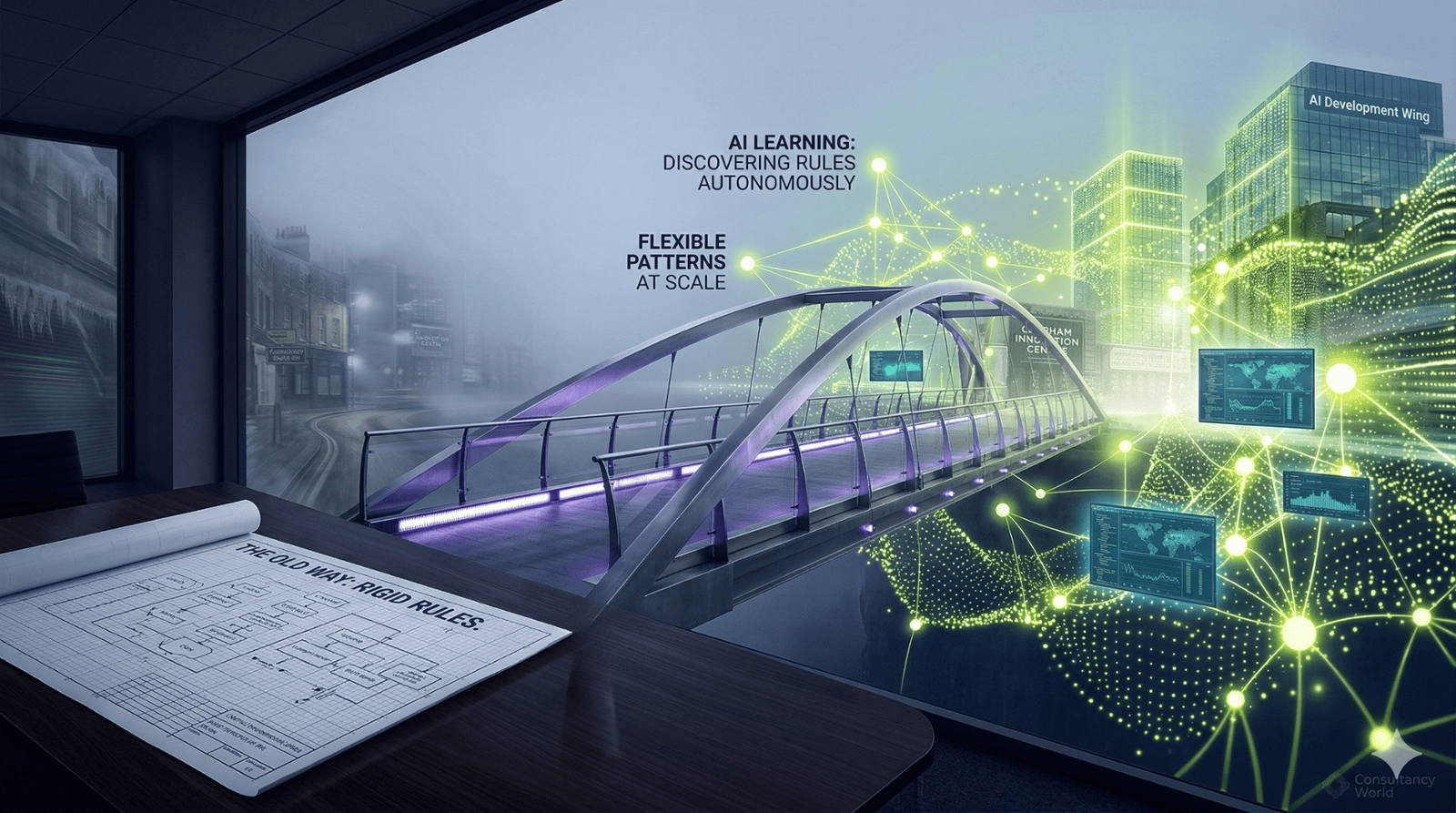
The Definition: AI is a shift from writing rules to curating examples.
The Reality: In 2026, we have moved past "chatbots" and into Agentic AI - systems that can actually do work, not just talk about it.
The Goal: To build a system that learns from your specific business data to find patterns humans miss.
Understanding Artificial Intelligence
The Core Definition
Artificial Intelligence refers to computer systems designed to perform tasks that would normally require human cognitive abilities. Unlike traditional software that follows rigid "If/Then" rules, 2026-era AI systems can:
Learn from Experience: They improve their performance as they encounter more of your business data.
Identify Hidden Patterns: They find relationships in complex datasets (like customer behavior) that a human analyst would miss.
Exercise Agency: Modern "Agentic AI" can now plan and execute multi-step tasks autonomously.
The Restaurant Analogy
Think of traditional software as following a recipe precisely-if an ingredient is missing, the process stops. AI is an experienced Executive Chef. They understand the goal (a great meal), know the ingredients, and can adapt the "recipe" on the fly based on what is happening in the kitchen.
The Three Types of AI: What Business Leaders Actually Need to Know
In 2026, the "hype" often blurs these lines. Here is the strategic reality:
Artificial Narrow Intelligence (ANI) - The ROI Engine This is what exists and delivers value today. It is brilliant at one specific task - like predicting equipment failure or personalising a marketing campaign - but it cannot do anything else.
Artificial General Intelligence (AGI) - The Horizon A hypothetical system with human-level flexibility across all tasks. Despite the headlines, AGI remains a "future" technology. Strategic Tip: Do not wait for AGI; the money is made in Narrow AI today.
Artificial Superintelligence (ASI) - Science Fiction Intelligence that surpasses human capability across every domain. This is not a factor for 2026 business planning.
The Strategic Imperative: Why It Matters Now
AI is no longer an "innovation project"; it is core infrastructure.
Operational Efficiency: Organisations are reporting 20–40% time savings on routine cognitive processes (Source: 2026 Industry Benchmarks).
Personalisation at Scale: AI-powered marketing now generates 5–8x higher ROI than generic campaigns by treating every customer as an individual.
The Competition Gap: PwC’s 2026 CEO Survey shows a widening "Competitiveness Gap" between firms with mature AI pipelines and those still stuck in the "experimentation" phase.
What AI is NOT: Clearing the Fog
AI is Not Magic: It requires clean data. "Garbage in, garbage out" is the #1 reason AI projects fail.
AI is Not "Plug and Play": It requires strategy, human oversight, and clear objectives.
AI is Not Always Right: Systems can "hallucinate" or carry biases from their training data. Human-in-the-loop remains the gold standard for 2026 governance.
The AI Implementation Journey
Success follows a progression, not a single event:
Education (Where You Are Now): Building the foundational knowledge.
Strategic Planning: Identifying the high-impact/low-risk "Quick Wins."
Pilot Implementation: Testing a single, measurable use case (3–6 months).
Scaling: Integrating AI into the "DNA" of your operations.